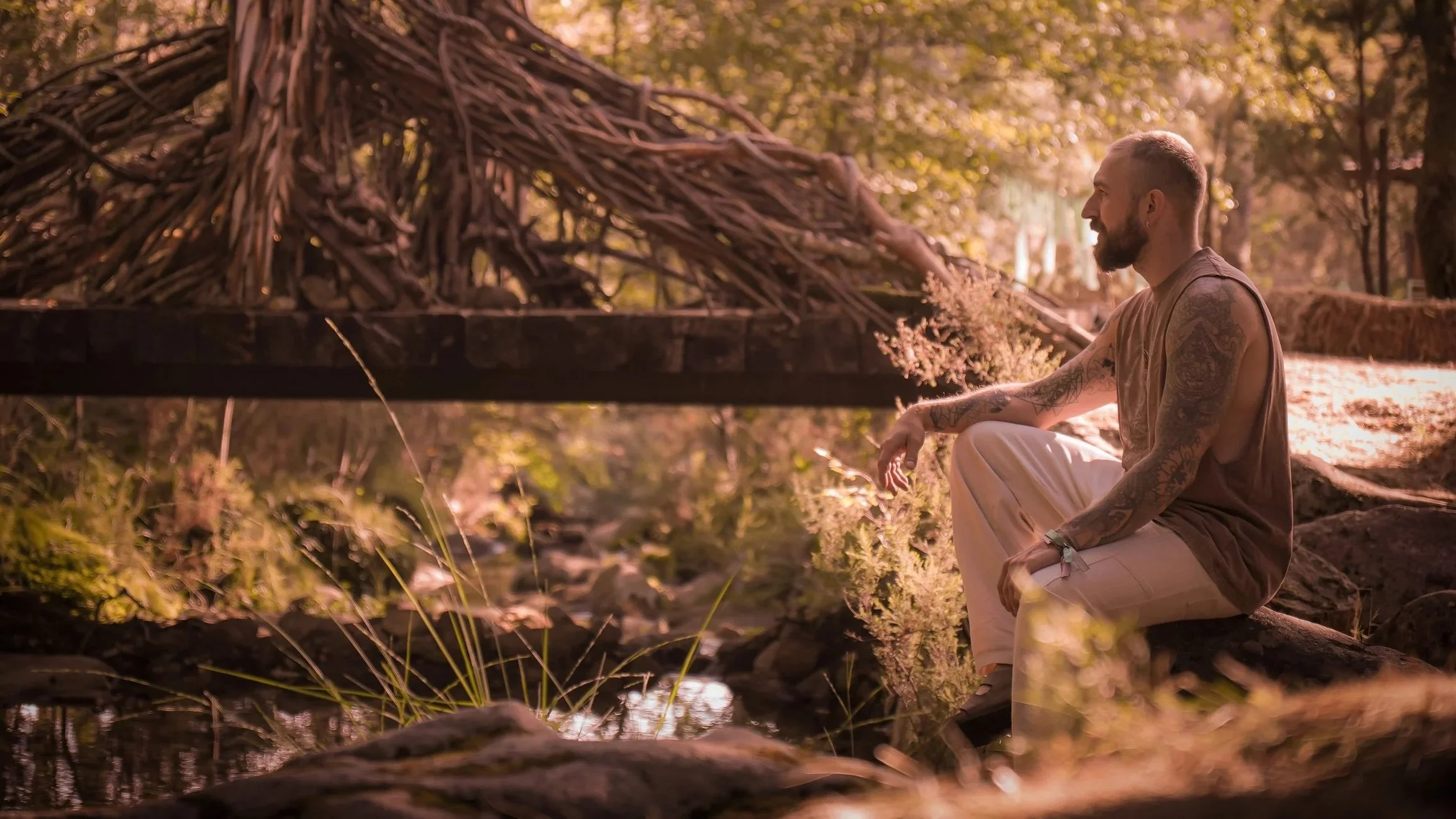
Kane & Living Inquiry
About
I’m Kane Rogerson. I teach yoga, meditation and inquiry in Ely, and offer one-to-one spaces for exploring the questions and difficulties that arise in our lives.
Living Inquiry brings together what years of practice, teaching and personal exploration have come to mean to me: a willingness to look honestly at our experience, question what we assume about ourselves, and become more available to the life we are already living.
01 / MY STORY
How I came to this work
Trying to become enough
For a long time, certainly since adolescence and perhaps even early childhood, I carried a feeling that something was missing. Alongside everyday life there was a busyness, a striving, a need to achieve. There was overthinking and a persistent sense that I needed to become something more. I was constantly trying to become enough to be accepted.
I have also always questioned life deeply. Even before I encountered formal teachings, I spent a lot of time wondering about existence, about myself, about why we live and feel the way we do.
Finding yoga
That search took me down some wrong paths. Eventually, it led me into yoga, where I found meditation, philosophy and a spiritual practice that resonated with questions I had been carrying for years.
I brought my hopes into those spaces too. Perhaps enough understanding, discipline or insight would finally leave me feeling accepted and complete.
I practised, studied and searched. There was real value in that. There were moments of awakening and beautiful teachings that changed the way I saw life.
When practice became another search
But after years of practising and expecting to get somewhere, I began recognising something uncomfortable. The practice itself had become part of the search.
The language had changed. What I was chasing now seemed deeper, more worthwhile. But underneath it was still the feeling that I wasn’t enough. Now I needed to become more aware, more spiritually evolved. Surely, after all this practice, I shouldn’t still be having these feelings and tendencies?
It was exhausting. Another book. Another teaching. Another promise that understanding the next thing would finally sort me out. And some of it was bullshit I was telling myself.
Looking at what was actually happening
Through meditation and inquiry, I began questioning the assumptions beneath all that effort. What was actually missing? What was I waiting to become before I could allow myself to be here?
I started looking more closely at what was happening. Who was telling me it wasn’t okay to feel sad? Who was saying I shouldn’t feel anxious? What was that voice trying to protect or achieve? Why did I need acceptance so badly, and what did I imagine it would give me?
The teachings of Papaji, Gangaji, Ramana Maharshi and Rupert Spira, alongside Eckhart Tolle’s The Power of Now, helped open a different relationship with practice. I began to recognise the movement of seeking as it happened, including the ways I could turn a beautiful teaching into another demand upon myself.
What began to loosen
There began to be moments when that movement relaxed. What struck me was how little needed to happen. I had been doing so much my whole life, and yet experience was still here. I was still here. Thought was still moving, but the demand to turn myself into somebody else had started to loosen, and with it, some of the struggle.
That understanding continues to unfold in everyday life. Anxiety, fear and sadness no longer automatically mean that something essential is missing or wrong, or that peace has been pushed further down the road. They have become part of the mystery of being alive. They do not have the same grip they once had at pulling me into a story about what I am.
I had spent years treating myself as a problem whose solution was somewhere in the future. Beginning to question that was enormous. It meant meeting what hurt, responding to what needed attention, and living without making every difficulty another verdict on who I was.
Why I share this work
Somewhere along the way, we can lose touch with the fact that vulnerability, uncertainty, sadness and fear belong to human life. We start treating them as evidence that we are getting it wrong. In my own experience, it was often that rejection, the insistence that I shouldn’t be feeling what I was feeling, that made them so intolerable.
This is why I do this work. I know the relief of discovering that there is room for what I had spent so long trying to get rid of. I know how much becomes possible when life stops being an endless assessment of whether I am enough.
That possibility is something I want to share.
What has Shaped my Teaching
02 / MY TEACHING
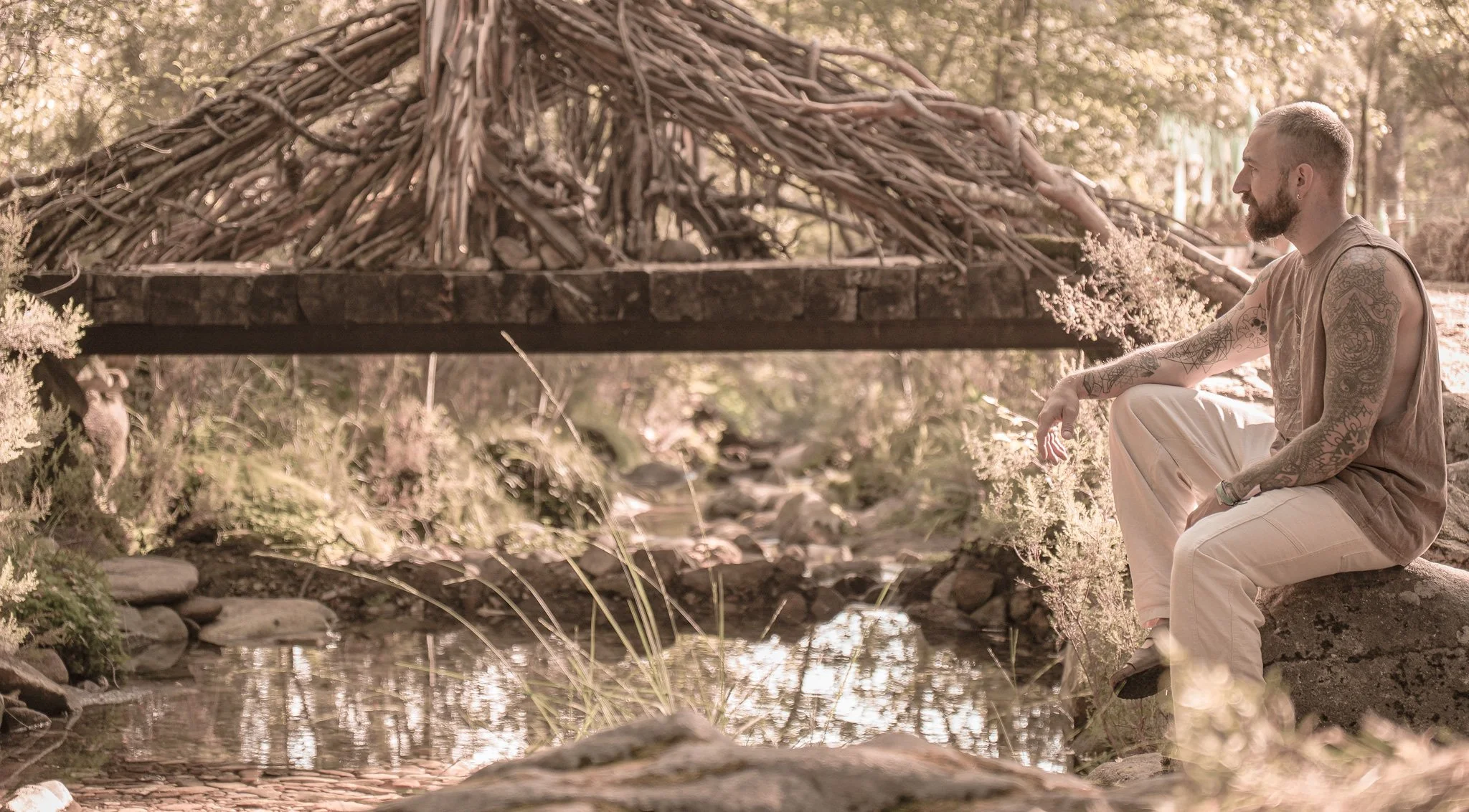
Learning through relationship
For many years I have been a student in Mark’s classes. That ongoing relationship has been an important part of my development, through the teaching itself and through the conversations, questions and practice surrounding it.
There is something valuable about staying with a teaching long enough to discover where you understand it and where you are simply familiar with its language. Life eventually brings you into contact with the difference.
This is one reason mentorship matters to me. Having someone with whom you can explore uncertainty, recognise a blind spot or admit that you do not know can allow understanding to mature. It gives the person who teaches somewhere to remain a student.
The value of practice
Yoga gave me ways to bring questions out of my head and into experience. Movement, breath, meditation and the study of philosophy became opportunities to observe how I actually related to myself.
A posture could reveal the need to achieve. Stillness could reveal how quickly I wanted to escape discomfort. A familiar practice could show me whether I was paying attention or simply going through the motions.
I remain grateful for the discipline and devotion within the traditions I have encountered, including Raja Yoga and spaces influenced by Jivamukti. Returning to practice has value. There are things we only notice when we stop rushing past them.
What matters to me now is the relationship we bring to that return. Practice can be an expression of curiosity and care. It can give us time to become familiar with something we have already glimpsed.
Questioning the spiritual identity
Over time, I became less comfortable with the expectations that can gather around spiritual practice. There can be a particular way to look, speak, think and behave, with an unspoken judgement about who belongs.
I recognised that tendency in myself too. It is possible to become attached to being the person who understands, who practises properly, who has the right outlook. Then anything that challenges that image becomes difficult to admit.
I want there to be enough honesty in my teaching for those things to be questioned. A practice needs room for the person who is tired, doubtful, irritated or confused. Those experiences can tell us something when we stop treating them as an embarrassment.
The invitation that changed the direction
What moved me in the teachings of Ramana Maharshi, Papaji and Gangaji was the invitation to investigate the one who was searching. So much effort had gone into improving my experience that I had rarely questioned the identity around which that effort was organised.
Rupert Spira’s exploration of awareness helped give clarity to something that can otherwise remain vague. We are aware of thoughts, feelings and perceptions. What do we actually know about the awareness through which they are experienced?
These teachings opened questions that I could explore for myself. Their value became apparent in the looking, in noticing what happened when an assumption was examined closely enough to lose some of its authority.
How that lives in a class
My teaching brings together movement, breath, meditation, philosophy and conversation. Some yoga practices are physically strong. Others leave more room for stillness. Throughout them, I am interested in how we listen.
Can we recognise effort without automatically pushing harder? Can we notice comparison without making it another reason to criticise ourselves? Can we remain curious when experience refuses to match our expectations?
In meditation, we may sit quietly, work with guidance or explore a question together. There is room for someone beginning for the first time and for someone whose years of practice have brought them to a difficult or unfamiliar place.
Continuing to learn
Teaching asks something of me as well. It asks me to notice when I am repeating an idea that I have stopped investigating, or offering certainty where a more honest response would be to remain with the question.
That is part of what I value in working with other teachers. We can look at how understanding becomes embodied in the way we speak, listen, respond and take responsibility.
I want the teaching to remain alive enough to keep changing me. That willingness to learn is part of what I bring into the room.
What I mean by Living Inquiry
03 / THE APPROACH
Beginning with what is here
Living Inquiry begins with the experience we are having now.
We may arrive with a question about a relationship, a recurring fear or the feeling that years of spiritual practice have left something unresolved. We give that question attention and explore how it is present in thought, feeling and the body.
Someone might describe feeling inadequate. As we look more closely, there may be a sentence repeating in the mind, an image of how life ought to be, or a tightness that appears when they imagine being judged. Something that initially seemed like a solid truth about the person begins to reveal its different parts.
That can create room to look again. We can take the experience seriously without assuming that its conclusion about us is true.
Awareness and the story of ourselves
Much of what we call ourselves is familiar because it has been repeated. Memories, fears, expectations and descriptions accumulate until they seem to form someone fixed and definite.
Inquiry allows us to examine that impression.
A thought about who I am can be noticed. A feeling associated with it can be felt. Even the conviction that this has always been my problem is appearing in awareness now.
What, then, is aware of it?
The question invites a moment of looking before we reach for an answer. Even the thought that we do not understand is being known. Awareness is already present in that experience. We have not had to complete a practice or settle an argument with ourselves to make it appear.
This recognition matters because we can spend years trying to improve the contents of experience while overlooking the simple fact that we are aware of them.
What nonduality points towards
In this work, nonduality concerns the sense that there is a separate me standing apart from life, trying to manage it, defend against it and obtain something from it that will finally make me whole.
We can explore how that sense of separation is formed. Is the self we are defending found as something fixed, or do we find sensations, images, memories and thoughts continually giving it shape?
Initially, recognising awareness may bring a sense of distance from the story. But the inquiry can continue. We can also question the impression of being a detached observer somewhere behind experience.
The possibility being explored is an intimacy with life in which that division becomes less convincing. Feeling, hearing, thinking and being are already happening together. We can investigate whether we are ever as separate from that wholeness as thought suggests.
When you have been on the path for years
You may already understand much of this intellectually. You may have had profound experiences, sat on retreats, recognised stillness and then wondered why familiar fears returned.
That is a meaningful place to begin.
Sometimes a moment of recognition becomes a memory we spend years trying to reproduce. We compare today’s ordinary experience with something luminous that happened before, and decide that we have lost what matters.
Inquiry can include that comparison. What makes us certain that awareness was present then and absent now? Is the frustration of this moment any less known than the peace of that one?
The return of a familiar pattern gives us something to explore. It does not automatically cancel what has been recognised. We can begin to see how understanding remains available within the very experiences we thought were obscuring it.
Allowing the human experience
For me, this becomes especially important around emotion.
There may be sadness, and then a judgement that sadness means we have failed. There may be fear, and then the demand to remove it before we can be at peace. Often that additional struggle is so familiar that we hardly distinguish it from the feeling itself.
We can approach it with care. What is being felt? What are we saying about it? What happens when we give the feeling a little room without deciding what it means about our worth or our progress?
Even resistance can be included. We do not have to punish ourselves for being unable to accept something. The part that wants to pull away may need attention too.
There is hope in discovering that we can meet experience without making it a test we must pass.
Letting understanding enter everyday life
This exploration belongs in the middle of life. It can inform how we respond to criticism, how we speak when we feel threatened, whether we ask for help and whether we allow another person to be different from us.
Sometimes a clear response is to change something. We may need rest, support, a boundary or a difficult conversation. Being present gives us an opportunity to see those needs more clearly.
This is why I call the work Living Inquiry. Recognition can be immediate, while its implications continue to unfold through our habits and relationships. There is always more to notice about how we live.
The hope is that life becomes less dominated by the project of securing ourselves. There can be more attention available for the person in front of us, more freedom to respond, and more room to appreciate being here.
04 / COMMUNITY
Practising together
Having somewhere to return to
There is value in having a place where these questions can be explored in company.
A regular gathering gives us time to become familiar with a practice and with one another. We can arrive with a different mood each week and discover that there is still a place for us. We can return to something we did not understand, or hear a question that brings our own experience into focus.
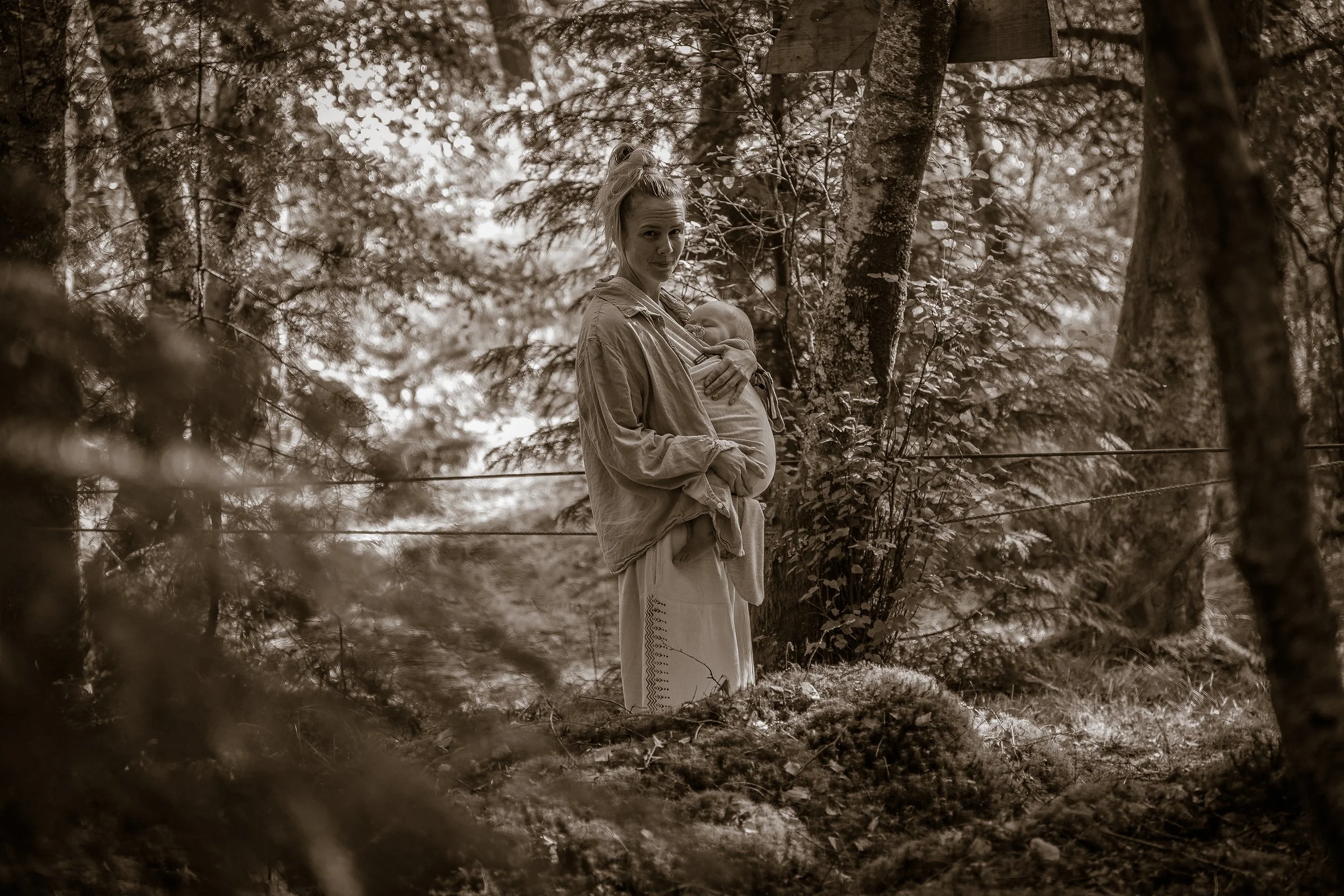
This is part of what Bee and I want to nurture around the gatherings in Ely. The classes are a beginning. Over time, we hope they can support a greater sense of connection in everyday life.
What travelling brought into focus
Travelling in the motorhome with our daughter, Leela, helped clarify that hope. At Buddhafield and KIND Family Gathering in Portugal, we encountered people sharing practice, meals, care for children and the work of being together.
What stayed with us was the feeling of participation. People had something to offer, and ordinary life had room around the organised activities.
It made us wonder what we could begin nurturing closer to home. There are already people doing valuable work locally. We would like to contribute to that, starting with the relationships growing around the classes.
Being able to arrive honestly
If the practice is concerned with meeting experience truthfully, the atmosphere around it matters.
I want there to be room to ask a question before it has become articulate. Room to say that a teaching does not make sense, or that an idea which sounds beautiful feels difficult to live. We learn very little about ourselves if we are busy giving the answer we think a teacher wants.
Someone who has practised for years may need space to admit their uncertainty. Someone who has never meditated may ask a question that takes us straight to something important. Both have a place in the conversation.
That kind of openness gives the work somewhere to deepen. We can stop spending quite so much energy on how we appear and give more attention to what we are discovering.
Understanding through relationship
Our relationships reveal things that solitary practice may leave untouched.
We may notice a need to be agreed with, a fear of being overlooked or the wish to appear more certain than we feel. When those movements become visible, we have an opportunity to respond with greater awareness.
This is also where kindness becomes practical. It might mean listening without rushing to explain someone’s experience, admitting that we misunderstood, or allowing a disagreement to remain without withdrawing respect.
I care about that connection between understanding and conduct. What we discover in meditation has a chance to become real in the way we treat the people around us.
Room for enjoyment and difference
I would love the gatherings to make room for more shared life, including food, walks, music, conversation and time outside. There is a place for laughter and ordinary enjoyment alongside serious inquiry.
People will want different levels of involvement. Some may simply enjoy attending a class. Others may want ongoing conversation or a deeper relationship with the practice. Belonging should leave room for those differences, with respect for each person’s boundaries and choices.
We can share a willingness to pay attention without needing identical beliefs or identical lives.
An invitation
You may be arriving with years of study behind you. Perhaps the teachings make sense, but something in the way you live still feels caught. Perhaps you are tired of turning every difficulty into more work on yourself.
You may also be starting with a quieter wish to slow down, move your body or spend time with people.
There is room to begin with either.
What I hope to offer is somewhere we can look honestly, practise with care and allow understanding to become part of life. Somewhere the questions can deepen without our humanity becoming a problem to overcome.
There is much we can learn, and there is also the possibility of discovering that we do not have to earn our place in the life already here.
You are welcome to explore that with us.